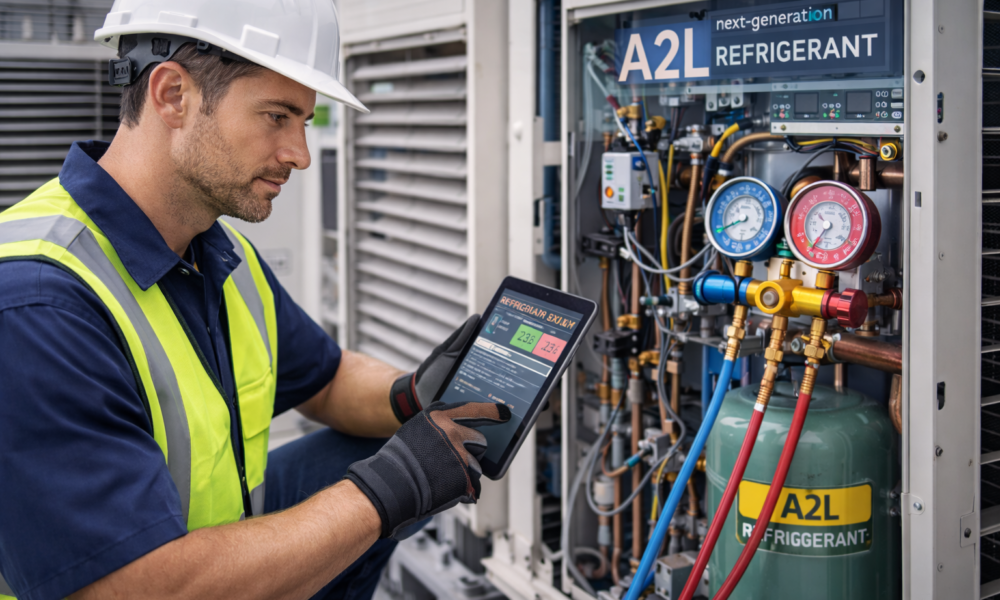
The cooling industry has always quietly powered modern civilization — keeping data centers humming, hospitals sterile, and homes livable in an ever-warming world. But for the first time in a generation, the refrigerant itself is changing, and the ripple effects are being felt from factory floors to certification boards.
The Phase-Out That’s Reshaping an Industry
High-GWP (Global Warming Potential) refrigerants, such as R-410A, were the mainstay of home and commercial conditioning for many years. While they were the undeniable industry standard due to their effectiveness and reliability, their environmental impact tells a different story. With a GWP of 2,088, discharging just one kilogram of R-410A into the atmosphere is over 2,000 times more damaging to the planet than carbon dioxide.
Regulatory bodies worldwide have taken decisive action. The American Innovation and Manufacturing (AIM) Act, the EU F-Gas Regulation, and the Kigali Amendment to the Montreal Protocol are all converging on the same conclusion: legacy refrigerants need to be phased out — and faster than many anticipated.
Enter the A2L Era
The replacements — refrigerants classified as A2L — are a different breed entirely. Gases like R-32 and R-454B carry GWP values that are 65–80% lower than the refrigerants they replace. They’re thermally more efficient, meaning equipment can achieve the same cooling output while consuming less energy. For environmental engineers and sustainability advocates, these numbers represent a genuine breakthrough.
But A2L refrigerants come with a trade-off. The “2” in their ASHRAE classification stands for “lower flammability” — a mild flammability characteristic that simply doesn’t exist with conventional options. Under specific conditions, such as high concentrations in an enclosed space near an ignition source, they can combust. The probability is low. The risk, if ignored, is not.
Why This Demands a New Mental Framework
Handling A2L refrigerants isn’t dramatically different from handling their predecessors — but the margins for error are tighter. Ventilation requirements are stricter. Leak detection protocols are more precise. Installation standards, particularly around ignition sources and room volume thresholds, must now follow updated guidelines from ASHRAE Standard 15-2022 and UL 60335-2-40.
For working technicians, the most important shift isn’t in tools or procedures. It’s in mindset. Treating an A2L system with the same casual approach used for R-22 isn’t a minor oversight — it’s a liability.
As we move toward a carbon-neutral 2026, the HVAC industry is undergoing its most radical transformation in decades. The introduction of A2L refrigerants like R-32 and R-454B is a win for the environment, but it introduces a ‘mild flammability’ factor that demands high-precision training. For technicians and engineers, mastering these new safety standards isn’t just about compliance; it’s about leading the green-tech frontier. To bridge the knowledge gap, many professionals are incorporating a diagnostic A2L practice test into their study routine, ensuring they can handle the technical 50-question board exam with the same precision they apply to their high-performance cooling systems.
Certification Is the Differentiator
The EPA’s Section 608 certification program now encompasses A2L-specific content across all technician certification tiers. The EPA’s official refrigerant management and certification program outlines the full regulatory framework — including the legal requirements every technician must understand before handling next-generation refrigerants. Staying current with these requirements isn’t optional; it’s a professional baseline.
Those who move early on A2L certification won’t just be compliant. They’ll be the professionals that contractors, building managers, and climate-tech developers actively seek out. In a tightening skilled-labor market, A2L expertise is rapidly becoming a hard skill with measurable market value.
The Bottom Line
The green transition in cooling is not a distant policy goal — it’s a current operational reality. Data centers are already specifying A2L-compatible systems. Commercial developers are writing it into building specs. Technicians who show up unprepared are increasingly being priced out of the industry’s most lucrative contracts.
The refrigerant shift signals something larger: the HVAC trade is evolving into a precision green-tech profession. Certification is no longer just paperwork. It’s the entry ticket to the next chapter of the industry.
Leave a Reply