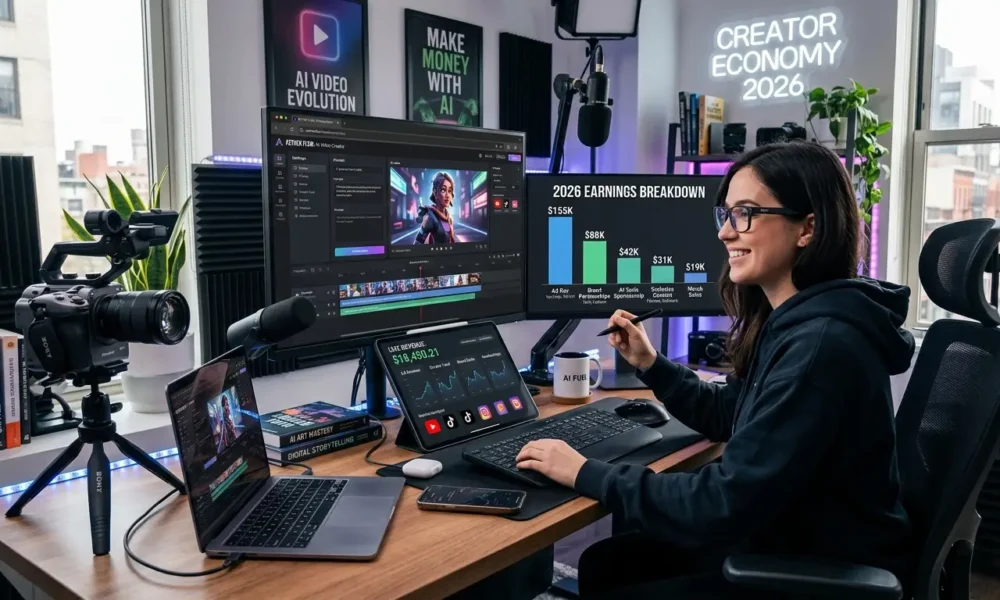
AI video is no longer just a fun tool for making clips. In 2026, it has become part of how creators build real income. What changed is not just video quality. What changed is the economics.
AI video lowers production cost. It cuts turnaround time. It makes content testing cheaper. That means creators can publish more, try more formats, and find what works faster.
That does not mean AI video prints money by itself. It does not. A weak idea is still weak. A bad offer still will not convert. And low-trust content still performs badly.
But if a creator already understands audience, messaging, and distribution, AI video can make the entire system more efficient.
That is where the money comes from.
In this article, I want to break down how creators are making money with AI video in 2026, which monetization models are working, and why workflow matters more than most people think.
Why AI video matters for creator monetization in 2026
The biggest reason AI video matters is simple: it changes the cost of making content.
A few years ago, if I wanted to test five video ideas, I usually had to pick one and hope it worked. The other four ideas stayed in my notes because filming, editing, and revising took too much time.
Now I can test more angles with less effort, and that changes creator monetization in three important ways.
Lower production cost means higher margin
If content costs less to make, more revenue stays with the creator.
This matters whether the creator makes money from ads, affiliate links, sponsorships, or digital products. Lower production cost improves the margin on every monetization model.
Faster output means more chances to find winners
Most creator income does not come from random luck. It comes from repeated testing.
You test a different hook, a different product angle, a different storytelling format, or even a different call to action.
AI video makes that testing cycle much faster.
More variations improve monetization odds
A creator who publishes one polished video might still lose to a creator who publishes five strong variations and learns faster.
That is why AI video matters. It does not replace skill. It increases speed and volume around a monetization strategy.
The five main ways creators are making money with AI video
There are many ways to monetize content, but most AI video income today falls into five groups:
- Ad revenue
- Affiliate marketing
- Sponsorships and brand deals
- Digital products
- Client work and services
Each one benefits from AI video in a different way.
1. Ad revenue from YouTube and short-form platforms
This is still the most familiar model.
Creators publish videos, grow an audience, and monetize views through platform payouts. AI video helps here because it makes consistent publishing easier.
That matters because ad revenue depends on scale. One video rarely changes everything. What matters is upload frequency, retention, topic fit, audience growth over time.
Why AI video helps ad revenue
It helps creators publish more often, with more visual variety, and with lower production friction.
That is useful for:
- faceless YouTube channels
- educational content
- niche explainers
- short-form storytelling
- list-based content
AI video does not automatically improve watch time. But it lets creators test more formats that might improve watch time.
The real advantage is consistency.
A creator who can produce three solid videos a week instead of one weakly edited video every two weeks has a much better chance of building monetizable traffic.
2. Affiliate marketing with AI video
This is one of the strongest monetization models right now.
Affiliate marketing works especially well with AI video because video is good at showing products, comparing options, and guiding people toward a click.
I think this is where a lot of creators underestimate AI. They focus on “viral clips” when the better use case is often commercial content.
Why affiliate works so well with AI video
Affiliate content usually needs:
- fast product demos
- clear explanations
- strong visuals
- frequent creative refreshes
AI video lowers the cost of producing all of that.
A creator can make product roundups, comparison videos, short-form reviews, how-to clips and top tools lists, all without setting up a full production workflow every time.
Where the money comes from
The affiliate model works when video content does one of these things:
- solves a problem
- shows a product in action
- compares alternatives
- gives a clear recommendation
That is why AI video affiliate content often works best in niches like:
- software
- creator tools
- productivity
- e-commerce tools
- online business
- education
Why more variations improve affiliate revenue
Affiliate income improves when creators test:
- different openings
- different recommendation angles
- different product positioning
- different visual styles
A static blog post gives one chance. AI video gives many.
That makes affiliate marketing one of the most practical AI video monetization models in 2026.
3. Sponsorships and branded content
Brands do not just want to reach anymore. They want output.
They want creators who can:
- move fast
- test concepts
- adapt messaging
- deliver multiple variations
That is why AI video is becoming useful for sponsorships.
How creators use AI video for brand work
Creators use AI video to:
- mock up campaign ideas before pitching
- create sponsor-friendly visual concepts
- produce UGC-style content faster
- localize branded content
- turn one campaign idea into multiple deliverables
That gives creators a strong advantage, especially if they work with smaller brands that do not have large internal production teams.
Why brands still care about trust
This part matters. AI video helps with speed, but sponsorship revenue still depends on trust. If the content feels generic, lazy, or off-brand, it will not perform.
So the winning approach is not “replace yourself with AI.”
The winning approach is “use AI to produce better sponsor content with less friction.”
That means clear messaging, audience fit, strong review process, brand-safe output.
The creator still matters. AI just makes the production side lighter.
4. Digital products and courses
This is the highest-margin model for many creators.
Instead of depending only on ads or brand deals, creators use content to sell courses, guides, templates, prompt packs, playbooks, and memberships.
AI video supports this model in two ways.
First, it helps sell the product
Creators can use AI video for:
- sales page explainers
- launch videos
- social promo clips
- course previews
- feature walkthroughs
That shortens the time between building a product and marketing it.
Second, it helps package the knowledge
A creator who teaches something can use AI video to turn:
- slides into explainers
- written lessons into visual summaries
- course updates into short announcements
That makes educational content easier to maintain.
Why digital products fit AI video well
This model works because the margin is high.
If AI helps reduce content production cost while the product price stays the same, profit increases.
That is one reason I see more creators moving toward AI-assisted product funnels rather than relying only on ad revenue.
5. Client work and creator services
Not every creator wants to become a media brand. Some want to monetize their skill directly.
AI video generators make that easier too.
A creator can offer short-form content packages, ad creatives, founder video systems, product demo videos, landing page explainer content, to startups, small businesses, and online brands.
Why this works
Most clients do not care whether a creator used a camera or AI. They care about speed, quality, clarity, and conversion potential.
If a creator can produce useful assets fast, that is valuable.
This model is often overlooked, but it can be one of the fastest ways to monetize AI video, especially for creators who already understand messaging and marketing.
Why affiliate marketing is one of the strongest AI video models
If I had to pick one model that fits AI video especially well, it would be affiliate.
That is because affiliate content benefits from three things AI video improves:
1. Speed of production
Affiliate opportunities move fast. New tools launch, features change, and creators need content quickly.
2. Volume of testing
Different product angles convert differently. AI video makes it easier to test:
- demo-first videos
- listicle videos
- review-style clips
- comparison videos
3. Lower cost per asset
A creator can make more monetizable content without spending thousands on production.
This is also where workflow platforms matter. If the creator is stacking too many disconnected tools, the speed advantage disappears.
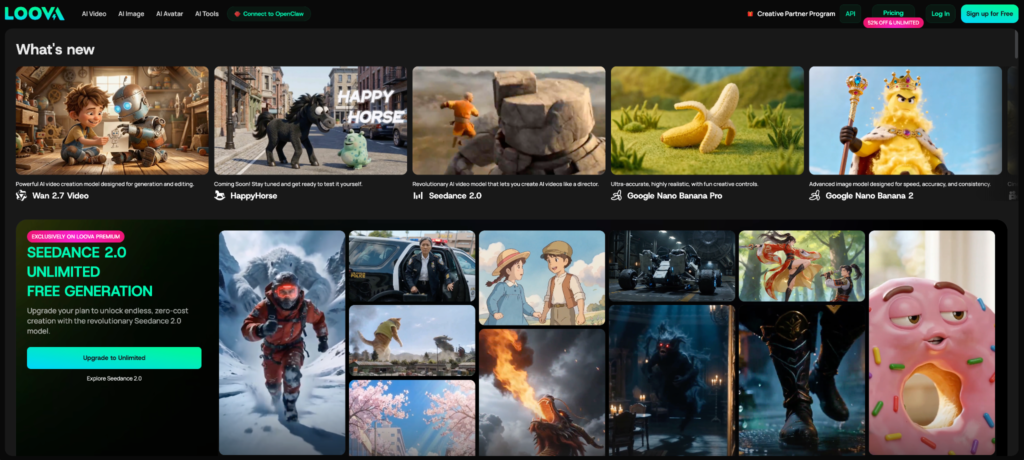
That is one reason creators increasingly use platforms like Loova for AI video workflows. When generation, editing, and iteration happen in one place, affiliate content gets easier to produce at scale.
How AI video improves YouTube and platform ad revenue
A lot of people assume more videos automatically means more money. That is not true.
The platform still rewards retention, clarity, topic alignment, and consistency. AI helps with the consistency part. It can also help with format testing.
For example, a creator can test:
- story-first intros
- faster visual pacing
- different background styles
- different narrative structures
That helps improve watch behavior over time.
Retention still matters more than volume
I want to be clear here.
Publishing ten weak videos will not outperform publishing fewer strong ones forever. AI video helps when it improves the output system, not when it floods platforms with low-value content.
That is why the best creators use AI to improve efficiency, increase testing, and support storytelling, instead of dumping meaningless content.
The AI video workflow behind successful monetization
This is the part many articles miss. Monetization does not depend only on content. It depends on workflow.
A creator who monetizes well usually has a repeatable system:
- Find a topic or offer
- Turn it into one or more repeatable video formats
- Publish consistently
- Track clicks, views, or conversions
- Improve what works
AI video helps when it fits into that system.
Formats matter more than random inspiration
The strongest creators are not asking, “What should I make today?”
They are asking:
- which format performs best
- which topic converts
- which creative angle deserves another variation
That is why repeatable content structures matter so much.
All-in-one platforms reduce workflow drag
Disconnected tools slow everything down.
One tool for image generation. Another for video. Another for editing. Another for voice. Another for export.
That stack becomes expensive and mentally heavy.
A unified platform reduces that drag. That is where Loova fits well for many creators. It helps keep content production, generation, and iteration inside one workflow instead of across five separate dashboards.
That matters more than most people realize.
What types of creators benefit most
Not every creator benefits in the same way. But some groups clearly gain more from AI video monetization.
YouTubers and storytellers
They benefit from faster visual production and more content experiments.
Short-form creators
They benefit from speed, variation, and trend adaptation.
Affiliate marketers
They benefit from more demos, comparisons, and creative refreshes.
Educators and solo founders
They benefit from explainers, course promos, and clear product content.
Small media teams
They benefit because AI lowers production cost without requiring a bigger headcount.
Common mistakes creators make when trying to monetize AI video
There are a few traps I see often.
Publishing low-value content at high volume
Volume is useful only when the content is still helpful or compelling.
Using AI visuals without a monetization path
A cool video is not a business model. The creator still needs a funnel, an offer, a trusted recommendation, and a clear CTA.
Ignoring audience trust
AI can help produce content faster, but it cannot fake trust. If the creator pushes irrelevant offers or low-quality products, monetization drops.
Using too many disconnected tools
This is a big one. Complex stacks reduce speed and increase burnout.
Chasing virality instead of building systems
One viral clip is exciting. A repeatable monetization format is worth much more.
How I would start monetizing AI video in a practical way
If someone asked me where to start, I would keep it simple.
Step 1: Pick one monetization model
Do not try to do ads, affiliate, brand deals, and product sales all at once. Choose one.
Step 2: Pick one repeatable content format
For example:
- tool comparisons
- product demo shorts
- story-based explainers
- niche educational clips
Step 3: Build a small prompt and content library
Save:
- successful prompts
- winning hooks
- proven structure
- best-performing CTA formats
Step 4: Track the right metrics
If the model is affiliate, track:
- clicks
- CTR
- conversion rate
If the model is ad revenue, track:
- retention
- watch time
- RPM trends
Step 5: Improve the system before scaling
The goal is not maximum output on day one. The goal is a repeatable workflow that improves over time.
The future of creator monetization with AI video
AI lowers the barrier to entry. That is good and bad.
It means more creators can produce useful content faster. It also means competition increases. That is why the future advantage will not come from access to AI alone.
It will come from better strategy, stronger trust, clearer offers, faster workflows, and better format testing.
In other words, AI makes execution easier, but it also makes lazy content easier. The winners will be the creators who use AI inside strong systems.
Final thoughts
Creators are making money with AI video in 2026, but not because AI is magic.
They are making money because AI changes the economics of content: lower production cost, faster publishing, more testing, and better workflow efficiency. That helps creators monetize through ads, affiliate marketing, sponsorships, digital products, and client services.
If I had to sum it up simply, I would say this:
AI video does not create income by itself. It creates leverage.
And creators who build repeatable systems around that leverage are the ones making real money.
If I were starting today, I would not chase every trend. I would choose one monetization path, one repeatable format, and one workflow platform that keeps production simple. For a lot of creators, that means using a unified system like Loova to reduce friction and produce more monetizable content without building a messy tool stack.
That is where the real advantage starts.
Frequently Asked Questions
Can creators really make money with AI video?
Yes. Creators are already using AI video to support ad revenue, affiliate marketing, sponsorships, digital products, and client work. The income comes from the business model, not the AI alone.
What is the best way to monetize AI-generated videos?
It depends on the creator, but affiliate marketing, ad revenue, and digital products are some of the strongest models because they benefit directly from faster content production.
Is affiliate marketing good for AI video creators?
Yes. It is one of the best fits because AI video helps creators produce more demos, comparisons, and product-focused content quickly.
Can AI videos get monetized on YouTube?
Yes, if they follow platform rules and provide real value. Monetization still depends on audience retention, originality, and policy compliance.
What are the best AI video tools for creators in 2026?
The best tools depend on workflow needs, but creators increasingly prefer platforms that combine video generation, editing, and creative variation in one place.
How do beginners start making money with AI video?
The easiest path is to pick one format and one monetization model first. For many beginners, that means short product videos for affiliate content or simple educational videos tied to digital products.
Do brands pay for AI-generated content?
Yes, but they still care about quality, fit, and trust. AI helps speed up production, but the creator still needs to deliver strong brand-aligned content.
Is AI video a real side hustle or just hype?
It can be a real side hustle if the creator uses it to support a clear monetization model. Without strategy, it stays hype. With a system, it can become a useful income tool.