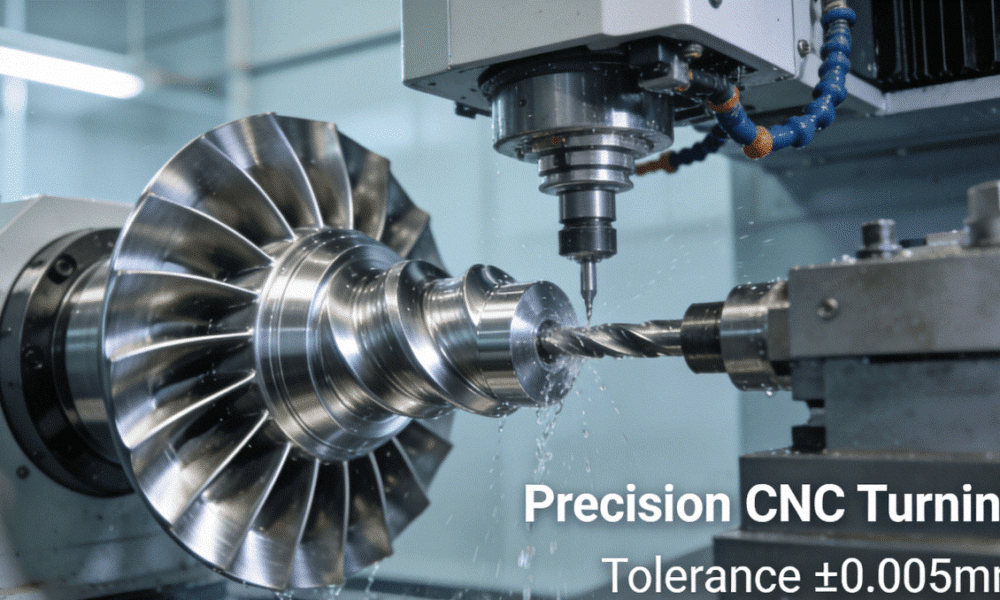
Introduction
The modern world of manufacturing is facing a new challenge as there is an increase in demand for high-precision, high-performance parts. In aerospace, for example, tolerance specifications such as ±0.005mm are now considered standard. However, with traditional methods of CNC machining, such as manual quoting and inefficient methodologies, it is not uncommon for projects to run over cost.
In this article, there is a discussion about introducing new and innovative methods of Precision Rapid Manufacturing, with instant quoting and optimization, to ensure that there are exceptional solutions for Custom CNC Parts, thereby improving precision while controlling cost. In the following sections, there is a discussion about how this is achieved.
Why is Precision CNC Turning Crucial for Aerospace Manufacturing?
In aerospace manufacturing, component reliability and precision are directly related to flight safety and performance. Precision CNC Turning is an important technology in this industry due to its capacity for economic production of rotationally symmetrical parts with outstanding roundness, concentricity, and surface finish. From compressor blades and fuel nozzles of turbine engines to precision shafts for landing gears, these components operate in extreme conditions of temperature and pressure, requiring near perfect precision with dimensional tolerances as precise as ±0.005mm.
Aerospace CNC Machining processes involve difficulties not just with precision but also with working with difficult-to-machine materials such as titanium and Inconel. Conventional processes struggle with these difficulties, resulting in cost overruns due to communication problems and inefficiencies. A study published in the International Journal of Advanced Manufacturing Technology found that improving CNC processes can lead to an increase of up to 20% in overall manufacturing efficiency. Hence, working with a service provider of professional precision CNC turning services, who has the capability to work with special materials and has the advantage of using tools such as instant quoting, has become the best practice in the industry to avoid such challenges.
How Can Instant Quotation Optimize CNC Turning Costs?
The traditional process of quoting for CNC components is a long and drawn-out process that involves several emails or phone calls, which can sometimes result in confusion and delays. However, an Instant Quote Manufacturing system can change the way cost management is conducted.

Shortening the Quotation Cycle and Improving Decision-Making Efficiency
A user can obtain an in-depth quote in just minutes with the help of intelligent algorithms just by uploading a 3D model file. This saves the user from the hassle of waiting for several days or weeks. In one case study, it was found that an aerospace supplier reduced the quotation feedback cycle for prototype development components by 70% with the help of an instant quote platform, resulting in an overall project cost reduction of approximately 20%.
Accurate Cost Calculation Based on Data
The accuracy of the instant quote system is based on the strength of the backend database.
- Transparent Material Costs:The instant quote systems are integrated with the latest databases like the ASM International material database. This allows the user to calculate the cost difference of various materials (like Aluminum 6061-T6 vs. Titanium Ti6Al4V), ensuring cost-effective design without compromising performance.
- Process and Certification Add-ons:The instant quote systems automatically calculate the part’s complexity, the required machining hours, and the additional processes needed (like anodizing or heat treatment). The key benefit is the inclusion of quality management costs like those required to meet the ISO 9001 standard. This ensures the user is aware of the control costs needed to maintain quality without additional costs being added later.
Design Optimization and Cost Linkage
An effective instant quote system should also be useful to the designer. For example, the designer may learn how to minimize the machining difficulty and cost of precision CNC turning parts through studying online resources related to precision milling and turning. This is achieved through small changes to the design, like the wall thickness of the part.
How Does the Precision CNC Turning Process Achieve ±0.005mm Tolerances?
The ability to achieve micro-level tolerances up to ±0.005mm is the definitive measure of Precision Rapid Manufacturing capabilities.
The fundamental steps involved in Precision Rapid Manufacturing are:
Precision design and programming, where CAD designs are converted into actual machine code, known as G-Code, which takes into account possible sources of error, like tool movement and expansion.The primary equipment used in Precision Rapid Manufacturing is a highly accurate high precision CNC turning center, which has micron-level accuracy in terms of positioning and repeatability, thus laying the groundwork for micron-level accuracy.In addition, highly accurate CNC milling machines can perform multiple functions in a single setup, thus eliminating possible sources of cumulative errors.
The environmental conditions, like temperature and humidity, are kept constant, and the fine-tuning by skilled technicians add up to a tolerance assurance system.This is clearly illustrated in a case study from JS Precision, where it is demonstrated that, with the implementation of a process such as AS9100D, a quality management system for aerospace, where all steps in production, from raw material to finished product, are systematically controlled, tolerances as precise as ±0.005mm can be achieved. Data from a respected authority states that, in a controlled environment, ultra-precision turning accuracy can be achieved to below 1µm.
How Do Precision CNC Turning Services Address Customization Challenges?
There is a rising need for Custom CNC Parts in industries such as aerospace and healthcare, which require complex geometries, functional integration, and extremely low production runs. Specialized precision CNC turning services are developed to address these customization requirements.
Flexibility for Complex Geometries
Contemporary multi-axis CNC turning machines are capable of turning parts that cannot be produced by conventional lathes. With the help of engineering assistance from CNC Machining Services professionals, customers can develop integrated designs with off-center holes, complex curved surfaces, and very fine threads, combining several parts into one to minimize weight and maximize durability.
Advantage of Low-Volume Rapid Response
Unlike conventional mass production, precision CNC turning is suited for low-volume, high-mix production. Digital technology and flexible manufacturing systems allow for rapid changeovers, making it possible to respond rapidly to prototyping, design modifications, and urgent spare part replacements.
Sustainable Customized Production
Customization should not have an environmental impact.
- Material Optimization and Waste Reduction:Advanced CAM programming software maximizes material usage and minimizes waste, which is particularly important for high-cost materials such as titanium alloys.
- Environmentally Certified Practices: The best service providers follow ISO 14001 environmental management practices to provide a green supply chain solution to their clients by ensuring eco-friendly practices in coolant disposal, scrap recycling, and energy consumption. To know more about how these services can be used for a project, information is available on the precision CNC turningservices page.
Future Trends: How Will CNC Turning Integrate with Smart Manufacturing?
In the future, Aerospace CNC Machining will be more integrated with smart manufacturing technology to elevate the level of CNC precision turning to a new stage. Artificial intelligence and machine learning technology will be used to further enhance Instant Quote Manufacturing and machining. For example, artificial intelligence can be used to more accurately predict tool wear and machining time during the instant quote manufacturing phase by using large amounts of historical machining data. Similarly, artificial intelligence can be used to adjust the machining parameters to counteract vibration during machining to improve machining speed and stability.
In addition, IoT technology will be used to connect all the equipment in the workshop to achieve transparent information and more accurate delivery time prediction.
These technologies will further solidify the position of Precision Rapid Manufacturing as the central part of the machining process, not just another machining method but an intelligent system for solving manufacturing problems more deterministically and cost-effectively.
Conclusion
In summary, precision CNC turning with the aid of instant quoting and optimization has the potential to revolutionize the efficiency and precision of the aerospace manufacturing industry. Experience the efficiency of smart manufacturing and gain reliable cost insights for your project.
Upload your 3D drawing now and get your free instant quote and start your efficient and precise manufacturing journey!
Author Biography
The author of this article is an expert in precision manufacturing with over ten years of experience in the field of advanced research and development and the application of CNC machining technology.
FAQ Section
Q1: What is Precision CNC Turning?
A: Precision CNC Turning is a computer-controlled lathe operation used for cutting materials by rotating the workpiece against a cutting tool. This process is used for the production of precise rotational parts with high roundness, with tolerances as tight as ±0.005mm, making it a critical process for industries like aerospace.
Q2: How to get an instant quote for CNC Turning?
A: The process involves uploading the CAD design file of the part to be machined, usually a STEP file or an IGES file, onto the online platform provided by the service provider. The design file is then processed by the system, and a detailed quote for the CNC Turning process is generated.
Q3: What are the main cost factors for precision CNC Turning?
A: The cost factors for the CNC Turning process can be listed as follows:Material type and quantity Part size and complexity of the part Tolerance requirements for the part Surface finish requirements for the part.
Q4: Is CNC Turning capable of working with non-round, complex parts?
A: Yes, modern multi-axis turning machines have the capability to do turning, milling, and drilling in a single operation, thus enabling the production of integrated parts with complex geometries such as flats, curves, and off-center holes.
Q5: What is the typical lead time for Precision CNC Turning?
A: In standard projects, the lead time between order confirmation and project delivery is approximately 1-3 weeks, depending on the project’s complexity, availability of materials, and capacity constraints. Instant quoting helps to speed up the initial workflow, and expedited services may also be available for critical projects.